Posted by Peter Jacob
Filed in Other 4 views
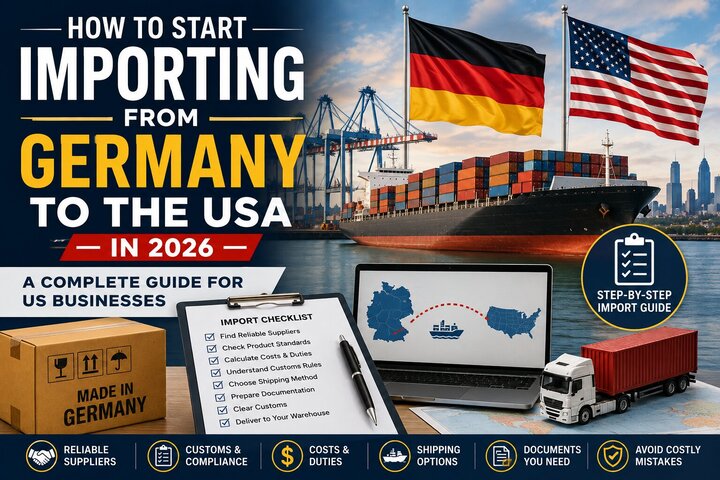
Germany has long been one of the world's most respected manufacturing and exporting economies. For American businesses, German suppliers can offer access to industrial machinery, automotive components, chemicals, medical equipment, electrical products, tools, specialty foods, and a wide range of consumer goods.
The opportunity is significant. U.S. Census Bureau data shows that U.S. imports of goods from Germany totaled $60.8 billion during January–May 2026, compared with $62.1 billion during the same period of 2025.
But successful importing involves much more than finding a German supplier and arranging transportation.
You need to understand the product, supplier, tariff classification, customs requirements, applicable regulations, shipping costs, documentation, and the current tariff environment before placing a substantial order.
This guide explains how to approach Germany imports in 2026 and how businesses can build a practical process for handling imports from Germany without unnecessary surprises.
Germany's reputation for engineering, manufacturing, precision, and quality makes it an attractive sourcing market for U.S. businesses.
American companies commonly look to Germany for products such as:
The important point is that importing from Germany does not have to mean buying finished consumer products.
A small American manufacturer, for example, might purchase a specialized German machine component that improves its production line. A distributor might source automotive parts. A retailer could import specialty consumer products.
The right opportunity depends on your industry and customers.
Before starting, it helps to understand the scale of the relationship.
Germany is part of the European Union, so US businesses need to consider both German commercial practices and the EU framework governing products leaving Germany.
At the same time, the United States applies its own customs and import rules when the merchandise arrives.
This creates two separate stages:
Germany/EU → Export requirements
USA → Import and customs requirements
Don't assume that because a product can legally be sold in Germany, it automatically meets all requirements for sale in the United States.
The two markets can have different standards, labeling rules, certifications, and regulatory requirements.
The first step in building a Germany imports strategy is choosing the right product.
Don't begin with the supplier.
Begin with the customer.
Ask:
This approach prevents a common mistake: becoming excited about a product simply because a German manufacturer offers an attractive price.
A product can be inexpensive at the factory and still be unprofitable after freight, duties, brokerage, storage, insurance, and domestic transportation.
Once you've selected a product, research its regulatory environment.
Some products are relatively straightforward.
Others may require additional approvals, testing, labeling, registration, or documentation.
Depending on the product, you may need to consider agencies or requirements involving:
CBP specifically notes that importers are responsible for ensuring merchandise meets requirements imposed by agencies such as FDA, EPA, DOT, CPSC, FTC, and USDA when applicable.
This is why product compliance should be investigated before you pay a supplier.
Now you can start looking for suppliers.
Potential sources include:
For serious commercial importing, direct manufacturer relationships can sometimes provide better information about specifications, production capacity, customization, and quality control.
However, don't automatically assume that a manufacturer is the best option.
A specialized distributor may offer smaller minimum orders or better support for an American buyer.
Compare suppliers based on the complete commercial relationship, not just the initial quotation.
Before sending a large payment, perform basic due diligence.
Check:
Confirm the company's legal name, address, website, contact information, and business registration details.
Ask whether the company actually manufactures the product or sources it from another business.
Find out whether the supplier regularly ships internationally, particularly to North America.
For significant purchases, consider requesting commercial references or other evidence of established business activity.
If quality is critical, ask about relevant quality-control systems, testing, certifications, and inspection procedures.
A supplier capable of producing 100 units may not necessarily be able to handle 10,000 units.
Your supplier must be able to support the volume you expect to purchase.
Never rely solely on photographs or a product catalog when quality matters.
Order samples.
Inspect:
If you plan to sell the product under your own brand, inspect the proposed packaging and labeling as well.
A sample gives you an inexpensive opportunity to identify problems before committing to a commercial order.
Once you approve a sample, create a written product specification.
Include details such as:
This document should become part of your purchasing process.
Don't rely on statements such as "same as the sample."
Write down what "same" actually means.
Clear specifications reduce disagreements and make quality inspections much easier.
Before production begins, agree on the major commercial terms.
Discuss:
Make sure both sides understand who handles transportation at each stage.
This is where understanding Incoterms becomes important.
Incoterms help define responsibilities between buyers and sellers in international transactions.
For example, an agreement may specify whether the seller or buyer is responsible for arranging transportation to a particular point.
Don't select an Incoterm simply because a supplier recommends it.
Understand what it means for:
Two supplier quotations can appear identical until you realize that one includes transportation to a particular destination while the other does not.
That difference can significantly affect your landed cost.
One of the most important technical steps in imports from Germany is determining the correct US tariff classification.
The United States uses the Harmonized Tariff Schedule of the United States, or HTSUS, to classify imported merchandise.
The classification can affect:
Don't simply copy a tariff code from your German supplier's invoice.
Germany and the European Union use their own customs classification framework. The EU uses the Combined Nomenclature, while the United States uses the HTSUS.
The first six digits may originate from the international Harmonized System, but additional digits and national tariff treatment can differ.
If classification is complicated, CBP offers a binding ruling program that can provide a binding pre-entry classification decision.
For an expensive or recurring product, getting classification right before your first major shipment can be extremely valuable.
This is especially important for businesses importing from Germany in 2026.
Germany is part of the European Union, and the US-EU tariff framework has changed significantly in recent years.
In an August 2025 joint statement, the United States and EU described a framework under which the United States would apply the higher of the existing US MFN tariff or a 15% combined tariff rate for originating EU goods, subject to specific product provisions and subsequent implementation. Certain categories were identified for different treatment.
A subsequent US presidential action specified that for EU goods with a Column 1 duty rate below 15%, the combined rate would reach 15%, while goods with a Column 1 rate of at least 15% would generally receive no additional reciprocal rate under that provision.
However, do not use 15% as a universal tariff rate for every German product.
Your actual tariff treatment can depend on:
Tariff policy can change, so calculate the rate applicable to your specific product at the time of entry.
The purchase price is not your real import cost.
A basic landed-cost calculation might include:
Product cost + German inland transportation + export charges + international freight + insurance + US duties + customs fees + brokerage + domestic delivery + other applicable costs
For example, imagine a business purchases $50,000 of machinery.
It might also incur:
The $50,000 supplier invoice therefore does not represent the actual cost of getting the machinery into your warehouse.
Calculate the complete number before deciding whether the transaction is profitable.
The best shipping method depends on your product.
Ocean transportation generally makes sense for larger commercial shipments where delivery speed is less important.
Advantages can include:
The trade-off is longer transit time and additional handling.
Air freight can make sense for:
The major disadvantage is generally higher transportation cost.
Courier services can be useful for:
For larger commercial shipments, compare courier pricing against freight options before deciding.
Where your goods enter the United States can affect the logistics cost.
Depending on the product and final destination, you might consider an East Coast, Gulf Coast, or West Coast port.
The cheapest international freight rate isn't necessarily the cheapest overall option.
Consider:
For example, if your warehouse is in Illinois, a shipment that arrives at a port with a slightly higher ocean rate might still be more economical if inland transportation is significantly lower.
Think about the entire route rather than only the ocean leg.
US businesses importing commercially need an appropriate importer identification number.
CBP states that a business's Importer of Record number is typically its IRS Employer Identification Number, while other entities may use an assigned Customs number under applicable procedures.
Make sure your business information is ready before the first shipment.
This avoids unnecessary delays when the goods arrive.
A customs broker can be extremely useful for a new importer.
A broker can assist with:
However, using a broker does not eliminate your responsibilities.
CBP states that hiring a customs broker is not legally required, but many importers use one for convenience. The importer remains ultimately responsible for understanding and meeting CBP requirements.
Choose a broker who understands your product category rather than selecting one based solely on price.
Commercial imports requiring formal entry can involve a customs bond.
A bond provides financial security for certain obligations associated with customs entry.
Your broker or surety can help determine what type of bond your business needs.
Don't wait until your cargo is already sitting at the port to discover that you need a bond.
Handle the requirement before the shipment departs.
Your shipment may require documents such as:
Make sure the information is consistent.
Pay particular attention to:
CBP explains that entry-summary documentation allows the agency to assess duties, collect statistics, and determine whether other legal requirements have been met.
A German supplier does not automatically mean every component in the product is German-origin merchandise.
Country of origin can depend on where the product was manufactured and, in some cases, where substantial transformation occurred.
This becomes important for:
Ask your supplier for reliable origin information.
Don't guess.
For larger purchases, consider a pre-shipment inspection.
An inspection can verify:
This is particularly useful for machinery and expensive equipment.
Discovering a manufacturing problem in Germany is much easier than discovering it after the product has crossed the Atlantic.
Some Germany imports require more than ordinary customs clearance.
For example:
Food imports can involve FDA and other requirements.
Medical devices and related products can involve FDA requirements.
Certain equipment may involve safety, electrical, environmental, or emissions requirements.
Vehicle and component imports can involve requirements from agencies such as NHTSA and EPA.
Chemicals may trigger EPA requirements and other regulatory obligations.
The key lesson is simple:
Customs clearance does not automatically mean the product is compliant for US sale.
CBP specifically advises importers to understand requirements imposed by other federal agencies where applicable.
Don't wait until your German supplier says, "Your order is ready."
Start logistics planning early.
Confirm:
This gives your freight provider enough time to arrange transportation.
It also reduces the risk of paying unnecessary expedited rates.
A low quotation means little if the supplier delivers inconsistent quality.
Evaluate total value.
The supplier's classification may be based on EU customs rules rather than US HTSUS treatment.
Verify the US classification.
Tariff treatment depends on the specific product and applicable measures.
Calculate it individually.
The US-EU tariff framework has changed, and tariff measures can be modified again.
Check current rules before each significant purchase.
A product can clear customs and still face other regulatory requirements.
Research those requirements before ordering.
Your cost doesn't end when the container leaves the US port.
Calculate delivery from the port to your warehouse.
A larger purchase can reduce unit cost but increase cash-flow risk.
Start with an order size that matches realistic demand.
For a first-time importer, the process can look like this:
1. Identify the product
↓
2. Research US demand
↓
3. Check regulatory requirements
↓
4. Find German suppliers
↓
5. Verify suppliers
↓
6. Order samples
↓
7. Establish product specifications
↓
8. Negotiate commercial terms
↓
9. Determine HTS classification
↓
10. Calculate current tariff treatment
↓
11. Calculate landed cost
↓
12. Select shipping method
↓
13. Arrange customs broker/bond if needed
↓
14. Place purchase order
↓
15. Inspect goods
↓
16. Prepare documents
↓
17. Ship
↓
18. File customs entry
↓
19. Pay applicable duties
↓
20. Deliver to warehouse
This process may look lengthy, but it becomes much easier once you turn it into a repeatable checklist.
Once you've completed several shipments, start studying your actual data.
Track:
Then compare the original estimate with the actual landed cost.
You may discover that a supplier with a higher factory price actually produces a lower overall cost because its products have fewer defects and require less inspection or replacement.
You might also discover that changing ports or shipment frequency saves money.
Good import management improves over time because every shipment creates useful information.
Starting Germany imports in 2026 can be a strong opportunity for US businesses, particularly those seeking high-quality industrial, technical, automotive, medical, consumer, and specialty products.
But successful imports from Germany require more than finding a good supplier.
You need a complete process.
Start with market demand.
Research the product.
Verify the supplier.
Order samples.
Document specifications.
Determine the correct US tariff classification.
Check the current tariff environment.
Calculate the full landed cost.
Understand customs and regulatory requirements.
Choose the right shipping method.
Prepare accurate documentation.
And build your logistics plan before the goods are ready.
The most important lesson is to avoid treating international importing as a single transaction.
It is a supply-chain process.
When you understand every stage—from German factory to US warehouse—you can make better purchasing decisions, reduce surprises, and build a sourcing operation that becomes easier to manage with every shipment.
Germany already has a substantial commercial relationship with the United States, and the volume of bilateral goods trade demonstrates that American businesses continue to source significant amounts of merchandise from German suppliers.
The opportunity is there. The businesses that approach it carefully are the ones best positioned to turn that opportunity into a sustainable import operation.
Common categories include machinery, automotive products, electrical equipment, chemicals, medical and scientific products, industrial components, and various consumer goods. The best opportunity depends on the specific US market and product category.
It can be, particularly for heavy machinery or bulky products. However, the actual cost depends on the product, shipping method, tariff classification, applicable duties, freight route, and domestic transportation.
The United States and Germany do not have a bilateral free-trade agreement. Germany is part of the European Union, and US-EU trade arrangements can affect tariff treatment for qualifying EU-origin goods. Current tariff treatment should be checked for the specific product before importing.
Ocean freight is often appropriate for larger commercial shipments, while air freight can make sense for urgent or smaller high-value cargo. Courier services can work well for samples and small shipments.
A customs broker is not legally required, according to CBP, but many businesses use one to manage customs paperwork and entry procedures. The importer remains responsible for compliance.
Add the product cost, German inland transportation, export charges, international freight, insurance, applicable US duties and tariffs, brokerage, port fees, domestic transportation, and other relevant expenses.